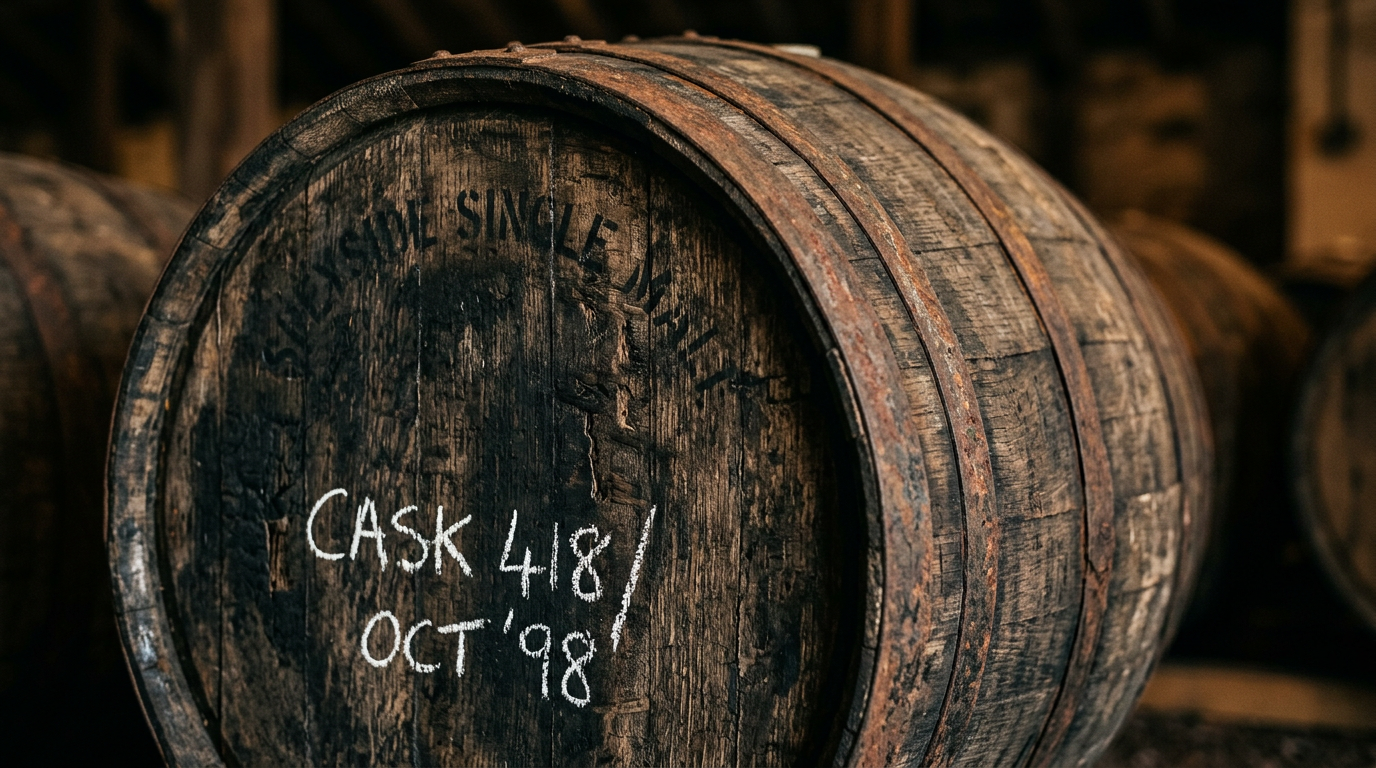
Why Provenance Matters More Than Age
Age is the easiest part of a cask story to understand. It can be stated, compared, and repeated. Provenance takes more effort. It asks where the cask came from, who has held it, how it moved, what was documented at each stage, and whether the record has stayed intact. That is why age alone rarely tells the whole story.
A cask may be old and still be poorly described. It may have spent decades in storage and still carry gaps in its record. Another may be younger, but so thoroughly documented that its identity is beyond dispute. For serious collectors, the second cask is often the more compelling object because the confidence attached to it is stronger. Age contributes to desirability. Provenance gives that desirability shape.
Age is one variable, not the verdict
Older spirit can be fascinating, but age is only one of the elements that determine whether a cask is genuinely interesting. The distillery matters. The fill matters. The warehouse matters. The condition of the cask matters. Most of all, the chain of custody matters. A cask with an elegant age statement but a weak history invites hesitation. A cask with a clean, complete history invites attention.
This is because age tells you how long a cask has existed. Provenance tells you what that existence has meant. It explains whether the cask remained in the right warehouse, whether its transfers were logged properly, whether the paper trail matches the physical object, and whether the custodian can account for it without ambiguity. In a category where scarcity is real, those distinctions are not decorative. They are the basis of trust.
What provenance actually contains
Provenance is not a slogan. It is a record. At minimum, it should show the distillery of origin, the spirit type, the cask type, the warehouse location, the date of fill, the dates of any movement, and the identity of the parties responsible for each handover. Ideally, it also includes photographs, warehouse receipts, valuation notes, and independent verification where that is available.
When those documents line up, the cask becomes easier to hold, insure, value, and ultimately transfer. When they do not, every future conversation becomes slower. Questions multiply. Confidence narrows. Even a good cask can become difficult to place if its history feels uncertain. That is why provenance is not a secondary detail. It is the framework within which age has meaning.
At Golden Casks, this is why the house insists on HMRC-bonded storage and CRT-tracked custody records. Those standards matter because they reduce room for ambiguity. They create a traceable route through the life of the cask. They allow the collector to see not just that the spirit has matured, but that its maturation has been properly held, documented, and accounted for.
Why the paper trail changes value
Two casks can appear similar on paper and still differ sharply in value once provenance is examined. The first may have an elegant age statement but a thin file. The second may be slightly younger, yet every transfer has been logged and every warehouse change recorded. The market tends to reward the second because certainty has value. It reduces friction for the next custodian and makes the asset easier to evaluate on its own terms.
This is especially true when a cask is considered for private holding, bottling, or future sale. A clean record shortens the distance between interest and action. It also helps preserve the narrative integrity of the cask itself. Collectors are not only buying liquid. They are buying continuity. The more complete the continuity, the more persuasive the cask becomes.
That is also why provenance often matters more than headline age when the two come into conflict. A very old cask with an incomplete history can be awkward. A younger cask with meticulous records can feel more dependable. In practice, serious collectors lean toward the object they can explain cleanly, not the one that merely sounds impressive in conversation.
HMRC-bonded and CRT-tracked
Golden Casks places unusual emphasis on HMRC-bonded and CRT-tracked custody because those controls support the broader claim that a cask has been kept properly. Bonded storage ensures the asset sits within an approved framework. CRT tracking ensures the movement and holding history can be followed with precision. Together, they create a standard that is harder to improvise and easier to trust.
This matters because provenance is strongest when it is cumulative. A good note from the warehouse is useful. A strong photograph is useful. A signed transfer record is useful. But when all of them are present, and when they sit inside a bonded and traceable custody process, the cask acquires a kind of documentary weight that age alone can never provide.
That documentary weight is what makes a collector comfortable holding for the long term. It is what makes the object easier to discuss with advisers, easier to explain to a future custodian, and easier to treat as an asset whose character is known rather than assumed.
The quiet advantage of completeness
The most elegant casks are often the ones that do not need to shout. Their value is quiet because the record is quiet. Nothing feels patched together. Nothing needs apologising for. The collector can see the path from fill to present holding and understand that the cask has been treated with care.
That, in the end, is why provenance matters more than age. Age can impress at a glance. Provenance sustains attention over time. Age says how long the cask has existed. Provenance says whether it has been properly kept while it did.
For Golden Casks, that distinction is central. A cask is only as convincing as the history that supports it. When the chain is complete, the age can speak for itself.
An allocation built around what you actually want to own.
Each conversation begins the same way — with a long answer to a short question. Tell us what you are exploring, and we will tell you what is in the cellar.
Open a Private Enquiry