
The Scottish Highlands: A Land That Shapes What It Keeps
The Scottish Highlands are not merely where heritage assets are stored. They are what shapes them. The lochs, the mists, the ancient granite — all of it shows up in the cask.
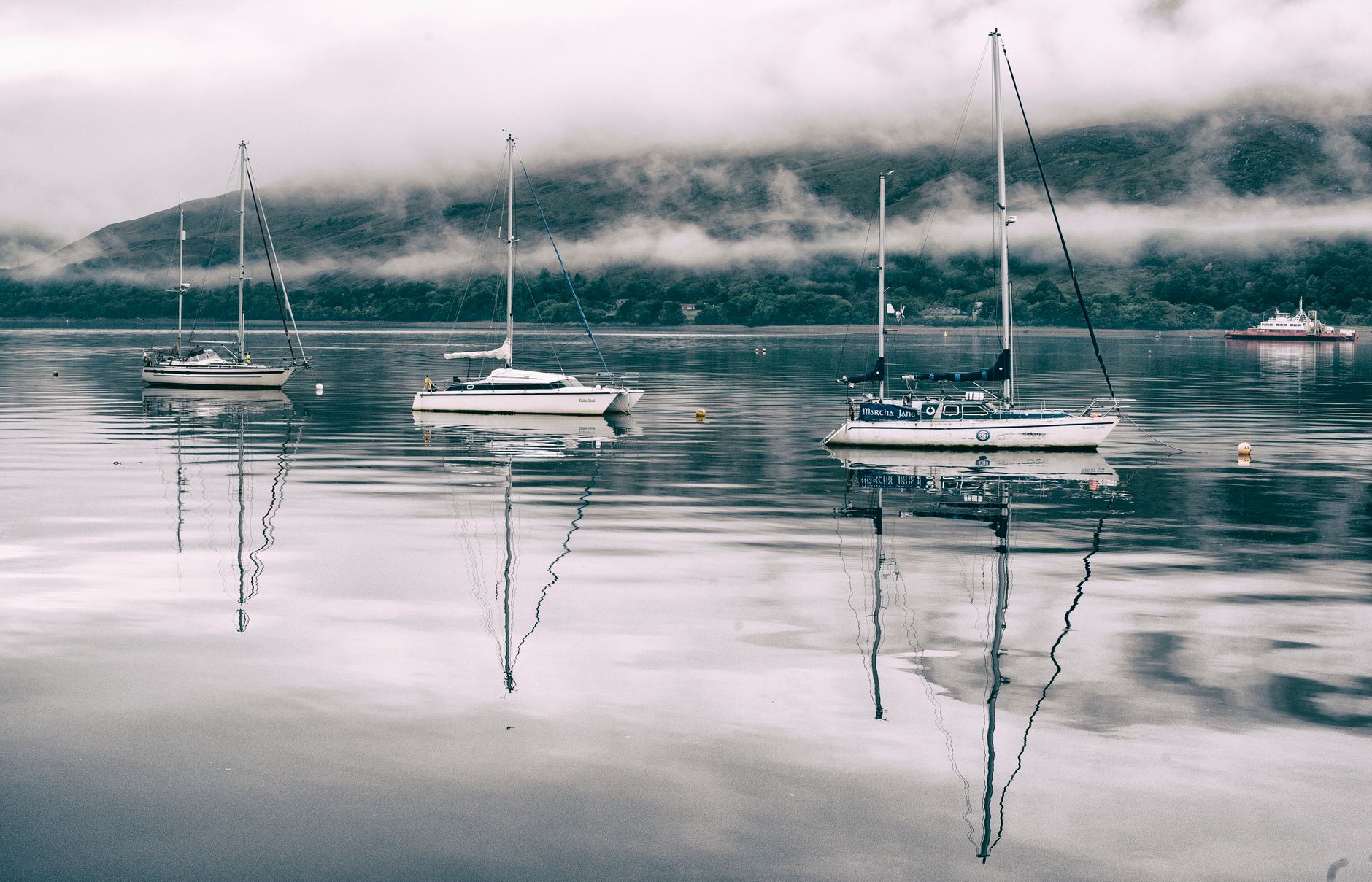
To understand what Scotland keeps, you must first understand Scotland itself — not the postcard version, though the postcards are beautiful enough, but the elemental reality of the land: the way the light moves across the moors in autumn, the cold shock of wind off the Atlantic, the particular quality of silence that settles over a Highland glen after rain. Scotland is not a passive backdrop to the craft carried out within it. It is an active participant. The landscape shapes what it holds.
A Geography of Extremes
Scotland occupies the northern reaches of the British Isles, pushing up into latitudes that would be inhospitable were it not for the moderating warmth of the Gulf Stream, which wraps around the western coastline and tempers what would otherwise be a much harsher climate. Even so, Scotland is a land of weather — of moods, of rapid change, of seasons that announce themselves clearly and depart reluctantly.
The Highlands in particular — the great swath of mountain, moor, and glen that occupies the northern two-thirds of the country — experience a climate unlike anywhere else in Britain. Winters are long and frequently severe, temperatures dropping well below freezing in the interior glens. Summers are short, bright, and unpredictable. Autumn arrives early and lingers with a particular golden beauty that has inspired poets and painters for centuries.
This variation in temperature across the seasons is not merely atmospheric. It is functional. The contraction of cold and the expansion of warmth drive a slow, rhythmic breathing inside every oak cask resting in a Highland warehouse — the contents pressing into the wood in summer, drawing back in winter. This annual cycle, repeated year after year over decades, is one of the primary mechanisms through which a maturing heritage asset develops its complexity and character. The seasons write themselves into what rests within the cask.
Water From Ancient Rock
Scotland's geology is among the oldest on earth. The Lewisian gneiss of the outer western isles dates back nearly three billion years — among the most ancient exposed rock anywhere on the planet. Across the Highlands, the landscape is shaped by granite intrusions, ancient seabeds folded by tectonic forces, and the scouring work of glaciers that retreated only twelve thousand years ago.
This ancient rock shapes Scotland's water in ways that are fundamental to heritage production. The burns and springs that rise through Highland granite are soft, low in minerals, and carry a purity that reflects the age and stability of the rock through which they have filtered. The water used in Scotland's heritage craft comes from these sources — from springs that emerge from hillsides untouched by industrial activity, from lochs and rivers whose catchments are high moorland and mountain. It is water that carries the character of the landscape as surely as the cask carries the character of the oak.
The famous lochs of Scotland — Ness, Lomond, Tay, Awe — are not simply scenic features. They are expressions of a landscape shaped by ice and time, reservoirs of soft, cold, mineral-rich water that has filtered through ancient geology. For the communities that have practised heritage craft beside these lochs for generations, the water is not incidental. It is essential. It is part of what makes what they produce uniquely Scottish.
The Atlantic Influence
Scotland's western coastline and island groups — the Hebrides, Orkney, Shetland — are exposed directly to the North Atlantic, and the winds and weather that blow in from that vast ocean define these landscapes entirely. Salt-laden air, frequent rain, dramatic storm fronts that build on the horizon and arrive with startling speed: this is the daily reality of life on Scotland's Atlantic edge.
The warehouses that dot the coastlines and islands of western Scotland are built to withstand this weather, and in withstanding it, they are shaped by it. The humidity of the Atlantic air enters the stone buildings, moderating the interior climate, influencing the rate at which the angel's share evaporates from each cask. Heritage assets matured on the coast develop characteristics — a briny, sea-kissed quality, a particular depth — that are simply not found in assets matured in the more sheltered inland glens.
This regional variation is one of the most fascinating aspects of Scottish heritage craft: the same process, carried out in different corners of the same small country, produces results that are recognisably different from one another — shaped by the specific microclimate of the specific location. A cask from a warehouse overlooking the sea on Islay is a different object from a cask matured in the Speyside valley, even if both began their journeys from similar starting points. Place is not background here. It is ingredient.
Heritage Passed Through Generations
The communities that have grown up around Scotland's heritage craft are inseparable from the landscape that produced them. In the villages and glens of Speyside, the Highlands, and the islands, the knowledge of how to work with the land — how to read its weather, how to use its water, how to work with the natural cycles of heat and cold — has been passed from generation to generation with the same fidelity as any other form of cultural inheritance.
This is knowledge that cannot be extracted from its context and replicated elsewhere. It is embedded in the landscape, in the communities that live within it, in the accumulated understanding of how this particular piece of earth behaves across a year, across a decade, across a lifetime. Families who have been involved in heritage craft for three or four generations carry within them an intuitive knowledge of the land and its rhythms that no instruction manual could fully capture.
The Scottish Highlands are, in this sense, not merely a location on a map. They are a living archive — of craft knowledge, of landscape intelligence, of the patient understanding of how time and place and skill combine to produce something that could not exist anywhere else in the world. Every heritage asset that matures beneath these skies carries within it a fragment of that archive. A piece of the land. A piece of the tradition. A piece of Scotland itself.
What the Land Leaves Behind
Visitors to the Scottish Highlands often speak of an overwhelming sense of ancientness — of standing in a landscape that feels as though it has existed forever and will continue to exist long after every human trace has faded. The mountains are old beyond imagination. The lochs are deep and cold and still. The moors stretch out in all directions under a sky that seems closer here than anywhere else.
It is in this landscape that Scotland's heritage craft finds its deepest meaning. The oak casks resting in the cool stone warehouses are not separate from this ancient world — they are part of it, shaped by it, expressing it in ways both material and metaphorical. What the land shapes, it keeps — and what it keeps, it transforms into something extraordinary. That is the gift and the promise of the Scottish Highlands, and it has been so for centuries.